
2026 Top Weight Plate Storage Racks for Global Buyers

Choosing the right Weight Plate Storage Racks is no longer a minor gym-design decision. It affects safety, workflow, floor space, and equipment life. In 2026, global buyers face a crowded market, with racks ranging from compact vertical trees to heavy-duty modular storage systems.

Veteran strength coach Dan John often expresses a useful training principle: “Make the important things easy to find.” That idea applies directly to plate storage. A well-designed rack keeps 20-kilogram plates within reach, reduces floor clutter, and limits unnecessary bending during busy sessions. It also helps staff inspect damaged plates, loose hardware, and unstable loading points before problems grow.

Small details matter.

This guide compares leading Weight Plate Storage Racks for commercial gyms, home facilities, schools, hotels, and international distributors. It considers weight capacity, steel thickness, base stability, sleeve length, finish quality, assembly requirements, and long-term maintenance. Shipping dimensions and packaging also deserve attention. A rack may perform well in a showroom but become costly when freight volume increases across borders.

Still, no single model fits every buyer. A compact rack may suit a private garage but struggle in a high-traffic training center. A premium frame can offer excellent durability, yet its price may exceed a smaller facility’s practical needs. These limitations deserve honest attention.

The selections below focus on usable performance rather than impressive specifications alone. Real-world handling, storage density, corrosion resistance, and replacement-part access all influence value. Buyers should verify current measurements and supplier terms before ordering. Specifications sometimes change. Experience has taught facility managers one thing: storage equipment should make training simpler, not create another maintenance problem.
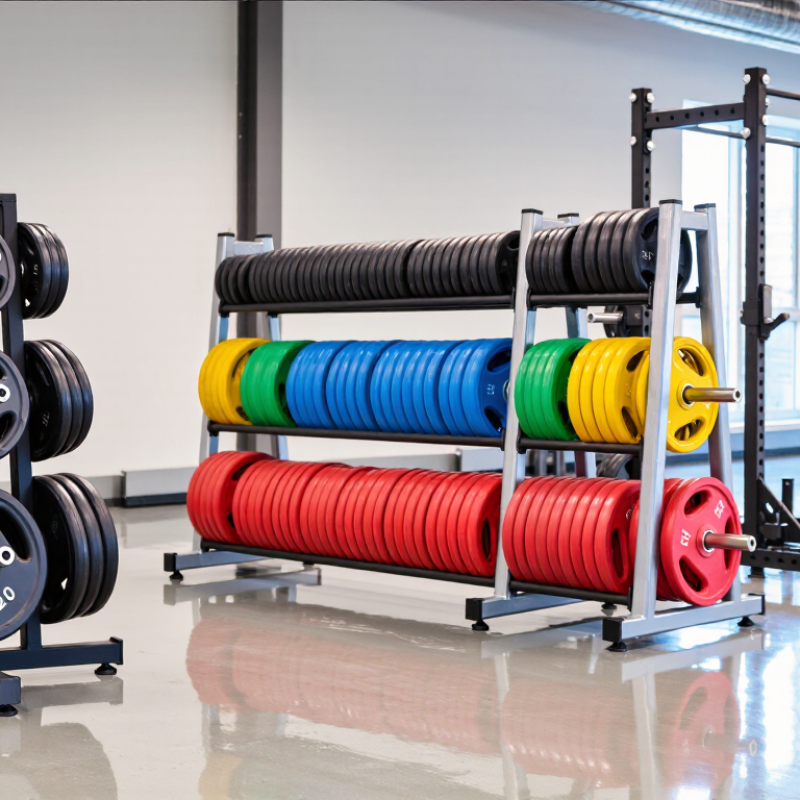
2026 Top Weight Plate Storage Racks for Global Buyers

50 mm Olympic Plate Standards: The Basis for Rack Compatibility

For global buyers, 50 mm Olympic plate standards are the starting point for rack compatibility. The diameter refers to the plate’s center hole, not its outer size. Most Olympic plates use a nominal 50 mm opening, while real measurements can vary slightly. Measure before ordering.

A compatible storage rack should have pegs that accept the plate bore without forcing it. Peg diameter, usable length, spacing, and rated load all matter. Bumper plates are often thicker than iron plates, so a short peg may waste storage capacity. Heavy plates also need a stable frame, wide feet, and secure floor contact. In practical inspections, I check the first and last plate positions carefully. Edge clearance is easy to overlook.

Tips: Ask suppliers for measured peg diameter and length, not only “Olympic compatible.” Confirm the rack’s load rating in kilograms or pounds. Check whether 50 mm plates from different suppliers slide smoothly. A small bore difference can cause friction, but excessive clearance may create movement and noise. Protective finishes help in humid gyms, though they do not replace routine inspection. One assumption deserves challenge: standard sizing does not guarantee universal fit. Manufacturing tolerances, thick collars, and unusual plate profiles can still create problems. Measure your actual plates. That extra minute may prevent an expensive mismatch.

Vertical, Horizontal, and A-Frame Racks: Comparing Three Storage Designs

Vertical, horizontal, and A-frame racks solve different storage problems for global gym buyers.

Vertical racks use limited floor space efficiently. They suit compact training rooms and facilities with tall ceilings. Plates slide onto upright pegs, keeping sizes visible and easy to access. However, a narrow base can feel unstable when users remove heavy plates quickly. Check the footprint, steel thickness, weld quality, and stated load capacity before ordering.

Horizontal racks place weight plates across low shelves or pegs.

They offer strong stability and simple loading, especially for busy commercial gyms. Their lower height also helps shorter users and reduces awkward lifting. The drawback is floor consumption. Measure walking clearance, not only the rack itself. I have seen buyers underestimate this space and create crowded training lanes. That mistake is easy to make.

A-frame racks provide a practical middle option.

Their triangular structure supports plates on both sides and often improves balance. They work well for mixed plate sizes and small studios. Yet, the center frame may obstruct movement if the rack is poorly positioned. Choose rounded contact points, protective feet, corrosion-resistant finishes, and clear assembly instructions. For international purchasing, confirm carton dimensions, net weight, spare hardware, and inspection records. Photos can look convincing. Measurements are more reliable. A sample setup or detailed technical drawing may prevent an expensive mismatch.

100–500 kg Load Ratings: Matching Rack Capacity to Plate Inventories

A 2026 weight plate storage rack should match real inventory, not optimistic purchasing plans. ACSM’s Worldwide Survey of Fitness Trends 2025 placed traditional strength training among the leading global fitness trends. That growth increases storage pressure in commercial gyms, schools, and training studios.

A 100 kg rack suits compact collections, such as six 10 kg plates and smaller change plates. A 250 kg model supports a broader mix, but operators should leave at least 20% unused capacity for safer handling and future additions. For example, a 200 kg inventory needs a rack rated near 250 kg, not exactly 200 kg. Capacity includes plates, pegs, trays, and attachments.

A 500 kg rack fits high-volume facilities with several lifting zones. The Global Wellness Institute’s 2024 report valued the physical activity economy at approximately 1.1 trillion US dollars, showing why organized fitness spaces continue expanding. Still, a higher rating does not guarantee stability. Check the floor, frame geometry, fasteners, and load distribution. OSHA 1910.176 also requires stored materials to remain secure and not create hazards.

Do not stack every plate on one side. That mistake is common. Actual plate weights can differ slightly from labels, and repeated impact may loosen hardware. A practical inspection log helps, although many facilities forget to maintain one. Choose capacity from measured inventory, expected growth, and handling habits—not only from the rack’s advertised maximum.

2026 Top Weight Plate Storage Racks for Global Buyers - 100–500 kg Load Ratings: Matching Rack Capacity to Plate Inventories

Rack Capacity Rating Recommended Working Load
(80% Planning Level)
Approximate Inventory
(20 kg Plates)
Recommended Rack Format Typical Footprint
(W × D × H)
Suggested Storage Layout Best Fit for Global Buyers Capacity-Matching Guidance
100 kg 80 kg 4 plates Compact vertical rack or two-peg wall-mounted rack Approx. 450 × 450 × 900 mm 2 storage pegs; suitable for small standard or Olympic plate sets Home gyms, apartment studios, small personal-training rooms Choose this level when the total stored plate weight is below 80 kg and floor space is limited.
150 kg 120 kg 6 plates Compact freestanding rack with a vertical plate tree Approx. 550 × 550 × 1,000 mm 3 storage pegs; separates frequently used plates from reserve plates Boutique studios, rehabilitation facilities, light commercial use Suitable for a compact plate collection with moderate daily access and limited expansion plans.
200 kg 160 kg 8 plates Four-peg horizontal or vertical freestanding rack Approx. 650 × 600 × 1,050 mm 4 pegs; supports basic separation by plate diameter or weight Small commercial gyms, apartment complexes, hotel fitness rooms A practical starting point for facilities storing up to eight 20 kg plates under normal usage.
300 kg 240 kg 12 plates Heavy-duty multi-peg rack with a wide stabilizing base Approx. 800 × 650 × 1,100 mm 6 pegs; enables grouping of bumper, iron, and fractional plates Busy strength gyms, school training centers, municipal fitness facilities Use when the plate inventory is growing or several lifting stations share one storage point.
400 kg 320 kg 16 plates Commercial plate-storage station with reinforced frame and multiple pegs Approx. 950 × 700 × 1,150 mm 8 pegs; supports high-volume access and clearer plate-size organization Large commercial gyms, sports-performance centers, institutional buyers Select this rating where multiple users regularly return plates throughout the day.
500 kg 400 kg 20 plates Extra-heavy commercial rack, modular storage bay, or anchored storage system Approx. 1,100 × 800 × 1,200 mm 8–10 pegs or mixed peg-and-shelf configuration High-volume gyms, athletic departments, training warehouses, multi-zone facilities Best for large inventories, frequent plate handling, and planned future expansion.
Planning notes: Inventory estimates use a 20 kg average plate weight: approximate plate count = recommended working load ÷ 20 kg, rounded down. The 80% planning level is a practical reserve below the stated rack rating; buyers should confirm the manufacturer’s tested rating, frame anchoring requirements, peg capacity, plate diameter limits, floor loading, and local safety requirements before installation. Footprints are typical planning dimensions and may vary by rack configuration.

ISO 20957-1 Safety Principles for Weight Plate Rack Construction

Global demand for strength equipment keeps rising. The SFIA 2024 Topline Participation Report recorded 242.1 million U.S. participants in at least one sport or fitness activity in 2023. ACSM’s Worldwide Survey of Fitness Trends for 2025 ranked traditional strength training fifth. Weight plate storage therefore needs more than attractive steelwork.

ISO 20957-1 provides general safety principles for stationary training equipment. It emphasizes stability, safe clearances, secure adjustment points, durable construction, and protection from sharp edges or crushing zones. A rack should remain stable when plates are removed unevenly. Load paths must be obvious. Welds deserve close inspection. So do floor anchors. ISO 20957-1 does not create one universal rack design, and it should not be treated as a standalone product certificate. Buyers should confirm the applicable scope, test method, and supplier documentation.

In practical checks, place the heaviest plates near the lowest storage pegs. Keep handles outside walking paths. Measure the rack after installation, not only on paper. A 450-kilogram rating may hide uneven loading assumptions.

That is a weakness. It needs questioning. The European Committee for Standardization’s EN 20957 framework is also useful when purchasing equipment for European facilities, but local requirements may differ.

Request material specifications, maximum load data, fatigue-test evidence, and maintenance instructions. A small clearance error can catch a finger. A loose anchor can move an entire rack.

Global Buying Criteria: Fit, Footprint, Steel Quality, and Shipping Efficiency

Global buyers need more than a strong-looking rack. Fit, footprint, steel quality, and shipping efficiency determine real value. Measure the available floor area before reviewing product drawings. Include plate diameter, handle clearance, and access space for users. Small mistakes matter. A rack may hold every plate but block a doorway or cleaning route. Adjustable storage posts can support different plate sizes, yet they may reduce usable capacity.

Steel quality affects stability, service life, and buyer confidence. Ask for steel grade, tube thickness, weld details, and tested load ratings. Smooth welds should show consistent finishing without sharp edges or visible gaps. Powder coating helps resist scratches and humidity, but it cannot repair weak steel. Do not trust weight alone. A heavy frame may still have poor joints or uneven balance. Request inspection photos, material documents, and clear tolerance information before production.

Shipping efficiency also protects the purchasing budget. Compare packed dimensions, gross weight, pallet use, and container loading plans. Knockdown designs often reduce freight volume and simplify warehouse handling. Confirm assembly instructions, hardware quantities, and replacement-part procedures early. Packaging should protect corners, posts, and painted surfaces from impact. However, tighter packing is not always better. Excessive compression can cause scratches or missing hardware. Recheck carton measurements against the final commercial invoice. Small errors become expensive across international shipments.

2026 Top Weight Plate Storage Racks for Global Buyers

Global buying benchmark based on four practical criteria: plate fit, floor-space efficiency, structural steel quality, and shipping efficiency. Scores are normalized from 0 to 100 using generic rack specifications rather than company or brand data.

How to read the chart: Compact vertical racks usually perform best for limited footprints and lower freight volume, while commercial multi-post racks provide stronger steel construction and higher storage capacity. Buyers should confirm plate-hole compatibility, maximum load, steel thickness, carton dimensions, and packed weight with suppliers before ordering.

Article Source: